latest

News-Stream

💡If these bulletins impart a trifle of value in your daily life, your support for CMP's 'Industry Service Provider of the Year' would be sincerely appreciated! CMP accepts nominations here. Canada's closely-watched 5-year bond yield is suddenly 38 bps higher year-to-date. That's

History Shows: Expect Unexpected Rate Detours

💡
If these bulletins impart a trifle of value in your daily life, your support for CMP's 'Industry Service Provider of the Year' would be sincerely appreciated! CMP accepts nominations here.

Canada's closely-watched 5-year bond yield is suddenly 38 bps higher year-to-date. That's swung bond market sentiment from partly sunny to cloudy in a hurry.

It makes this an opportune moment to dust off an old cliche: rates don't drop in a straight line. We've got to brace for intermittent zig-zags, the only normal in downtrends.

Of course, we hear this all the time. It's more instructive to actually see it.

On that note, you'll find charts below of all five BoC rate cut cycles this millennium. The arrows point to bond selloffs (yield rallies) in an overall downtrend. The terminus is the same in each case—rate cuts—but as you'll see, yields take many temporary detours along the way.

You don't have access to this post on MortgageLogic.news at the moment, but if you upgrade your account you'll be able to see the whole thing, as well as all the other posts in the archive! Subscribing only takes a few seconds and will give you immediate access.

This post is for MLN Pro subscribers only

Subscribe now
Back to top

After almost 18 years, the man who built Scotiabank’s mortgage broker business retired last month. John Webster’s departure and Scotiabank’s pullback from mortgages last year left some wondering how committed the bank was to brokers and rate competitiveness. To find out, we connected with the person stepping

Tracy Gomes Lays Out the Blueprint for Scotiabank's Mortgage Future

After almost 18 years, the man who built Scotiabank’s mortgage broker business retired last month. John Webster’s departure and Scotiabank’s pullback from mortgages last year left some wondering how committed the bank was to brokers and rate competitiveness.

To find out, we connected with the person stepping into Webster’s big shoes, Tracy Gomes, Senior Vice President of Real Estate Secured Lending at Scotiabank.

In this important interview, a gracious and transparent Gomes talks about how brokers fit into Scotiabank’s long-term plan, rate competitiveness, the bank’s digital eHOME channel, mortgage funding and branch relevance.

Here’s what she had to say on that and much more (key points are highlighted)...


On whether the bank's commitment to mortgage brokers has changed

You don't have access to this post on MortgageLogic.news at the moment, but if you upgrade your account you'll be able to see the whole thing, as well as all the other posts in the archive! Subscribing only takes a few seconds and will give you immediate access.

This post is for MLN Pro subscribers only

Subscribe now
Back to top

💡Reader note: Stay tuned for tomorrow's MLN exclusive with Scotiabank's new mortgage head, Tracy Gomes. She outlines the bank's broker and digital mortgage plans for 2024. The Bank of Canada is feeling tension after Tuesday's frustrating inflation data. But economists never expected

Inflation Approaching Make or Break Moment. Mortgagors on Edge

💡
Reader note: Stay tuned for tomorrow's MLN exclusive with Scotiabank's new mortgage head, Tracy Gomes. She outlines the bank's broker and digital mortgage plans for 2024.

The Bank of Canada is feeling tension after Tuesday's frustrating inflation data. But economists never expected great things from this report to begin with. Inflation's acceleration last month was as foreseeable as sunrise, mainly because the year-ago comparable was so unfavourable.

It's what happens this quarter that really matters. And now it gets real because Canadian and U.S. headline inflation have made no progress for six months. Moreover, challenging #base effects# are out of the way and can no longer be used as a scapegoat.

If the BoC doesn't get what it wants in the next few reports, we may shift from speculating about rate reductions to having a heart-to-heart on hikes. But that's not the mainstream expectation, so we might as well stay optimistic.

Before getting into the devilish details, here are today's latest readings:

  • Headline inflation: + 3.4% (v.s 3.1% last month and 3.4% consensus)
  • Avg. core inflation: +3.73% (vs. 3.67%, and up a disappointing 0.4% m/m)

Commentators blamed those aforementioned base effects for the uptick in the headline number, with gasoline prices playing a pivotal role—an inflation phenomenon felt globally, not just in Canada.

The real head-turners for the Bank were the two core measures. Markets expected them to slow. Instead, they not only rose, but prior months were revised higher. And note, "These are central tendency inflation measures totally unaffected by outlier price changes like mortgage interest," reminds Scotiabank Economics economist Derek Holt.

You don't have access to this post on MortgageLogic.news at the moment, but if you upgrade your account you'll be able to see the whole thing, as well as all the other posts in the archive! Subscribing only takes a few seconds and will give you immediate access.

This post is for MLN Pro subscribers only

Subscribe now
Back to top

Predicting lower rates has become a national pastime. With millions of mortgage shoppers becoming armchair forecasters, rate-cut expectations have led to a higher-than-normal share of Canadians considering short-term mortgages. Yet, for months, such borrowers have been frustrated by the fact that longer-term rates (e.g., 5-year terms) have fallen much

Yield Curve U-Turn: Mortgage Market Un-Inversion in Progress

Predicting lower rates has become a national pastime. With millions of mortgage shoppers becoming armchair forecasters, rate-cut expectations have led to a higher-than-normal share of Canadians considering short-term mortgages.

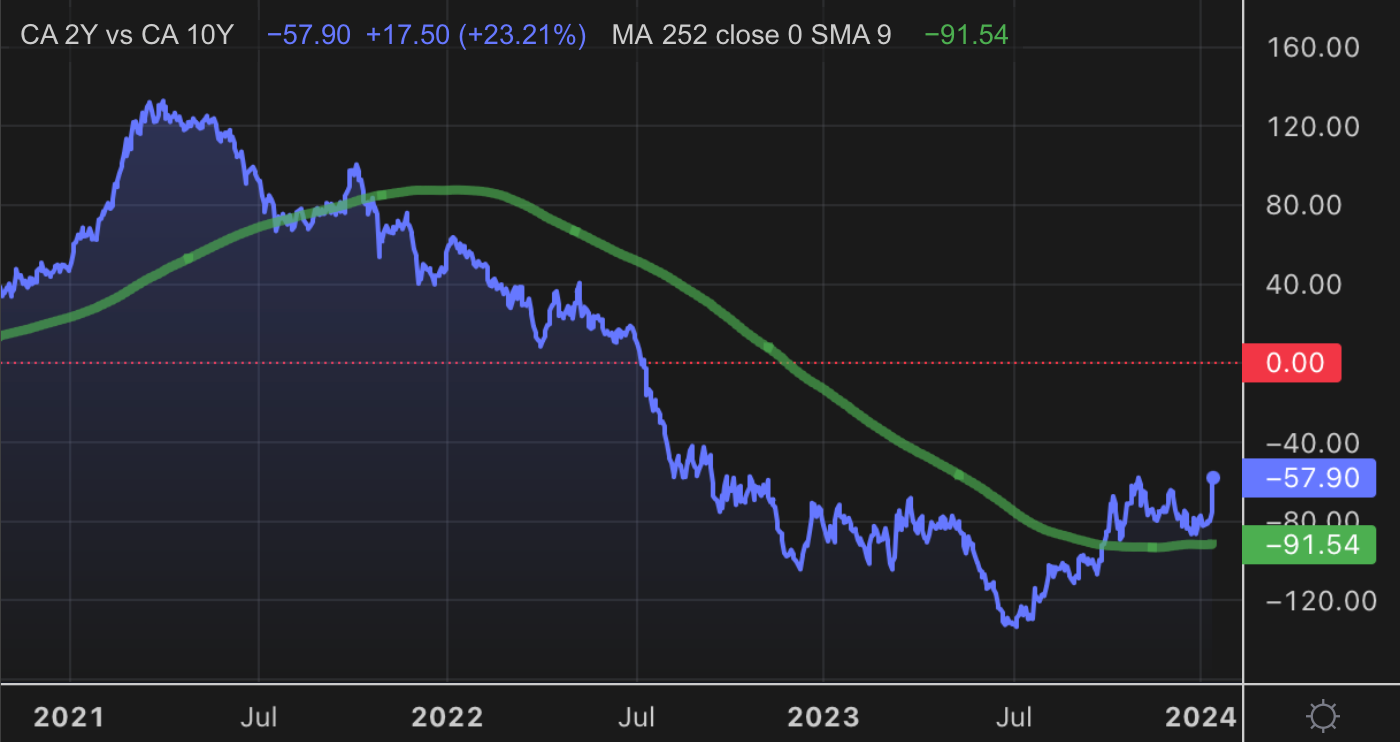
Yet, for months, such borrowers have been frustrated by the fact that longer-term rates (e.g., 5-year terms) have fallen much quicker than 1- and 2-year rates. Well, hold on to your toques because there's finally good news on that front.

You don't have access to this post on MortgageLogic.news at the moment, but if you upgrade your account you'll be able to see the whole thing, as well as all the other posts in the archive! Subscribing only takes a few seconds and will give you immediate access.

This post is for MLN Pro subscribers only

Subscribe now
Back to top

Two-year bond traders are going all-in on rate-cut bets. Exhibit A is the following chart. It shows Canada's 2-year yield, a leading indicator for BoC rates. It just made an 8-month low on Friday after failing to rebound above its 18-month average. To some, technical analysis might seem

2-Year Bond Yields Dive, Signaling Rate Relief Ahead

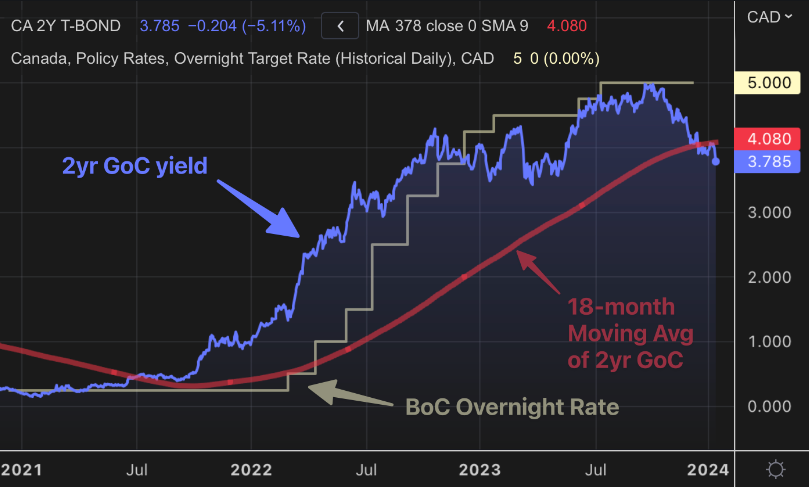
Two-year bond traders are going all-in on rate-cut bets. Exhibit A is the following chart. It shows Canada's 2-year yield, a leading indicator for BoC rates. It just made an 8-month low on Friday after failing to rebound above its 18-month average.

2-year Canadian Yield (Source: Refinitiv Eikon)

To some, technical analysis might seem like financial voodoo, but history doesn't lie. When the 2-year yield undershoots its 18-month moving average without a significant bounce, that's historically been a harbinger of BoC cuts within three to twelve months.

You don't have access to this post on MortgageLogic.news at the moment, but if you upgrade your account you'll be able to see the whole thing, as well as all the other posts in the archive! Subscribing only takes a few seconds and will give you immediate access.

This post is for MLN Pro subscribers only

Subscribe now
Back to top

ℹ️Also below • A landlord "trick" to bypass rent control • BoC repo action triggers liquidity fears • CMLS revamps mortgage broker incentives • Mortgage Bytes This could be the best year for mortgage investment corporation (MIC) returns in decades, at least for some of them. That's the outlook

Antrim's Insider Scoop on Surging MIC Returns

ℹ️
Also below
• A landlord "trick" to bypass rent control
• BoC repo action triggers liquidity fears
• CMLS revamps mortgage broker incentives
• Mortgage Bytes

This could be the best year for mortgage investment corporation (MIC) returns in decades, at least for some of them.

That's the outlook from the head of Canada's largest residential MIC, Will Granleese, Director and Portfolio Manager at Antrim Investments. His MIC has been around for three decades, and when asked about 2024, his reply was glowing: "I see this as a golden age for private lending."

That would strike some as unintuitive—i.e., that a MIC manager is popping champagne bottles when the housing market is supposedly heading towards recession. To get some context, we caught up with Will a few weeks ago. He served up an insider's scoop on why non-institutional mortgage lending could be this year's Cinderella finance story.

You don't have access to this post on MortgageLogic.news at the moment, but if you upgrade your account you'll be able to see the whole thing, as well as all the other posts in the archive! Subscribing only takes a few seconds and will give you immediate access.

This post is for MLN Pro subscribers only

Subscribe now
Back to top
For those with a few bucks and a dream, playing Monopoly with real-life rental properties could again become a pastime in 2024/25. To set that stage, let's start with six truths that bolster the case for rental investing: 1. Rents have soared double-digits to record highs — any

The Rental Investment Train Could Leave the Station By Spring. Should You Be On It?

For those with a few bucks and a dream, playing Monopoly with real-life rental properties could again become a pastime in 2024/25.

To set that stage, let's start with six truths that bolster the case for rental investing:

  1. Rents have soared double-digits to record highs — any higher and they'd need a space suit
  2. Mortgage rates should test gravity further in 2024, with at least four BoC cuts now fully priced in
  3. Lower rates stoke demand and appreciation; other things equal
  4. 7-figure population growth also fuels our extreme housing demand
  5. Almost no reputable economists are projecting high unemployment
  6. Despite government incentives, it may be years before builders are willing and able to build fast enough.

Knowing the above, countless potential property investors wonder if they should take the plunge and buy before the crowd. They know what prices can do when rates dive in a tight real estate market. And they know that the best way to build wealth in a country where ¾ of us say we're overtaxed is to amass tax-efficient capital gains.

So with that, let's unwrap this mystery box of a question, and sprinkle in some investing best practices while we're at it.

You don't have access to this post on MortgageLogic.news at the moment, but if you upgrade your account you'll be able to see the whole thing, as well as all the other posts in the archive! Subscribing only takes a few seconds and will give you immediate access.

This post is for MLN Pro subscribers only

Subscribe now
Back to top

In the last three months of 2023, the 4-year swap rate—a leading indicator of fixed mortgage pricing—plunged 125 bps. The descent trimmed down fixed rates by about 60 bps. For the average Joe/Josephine getting a new $300,000 mortgage, that means a cool $8,700 that they

Employment Labyrinth: A U.S. Beat and Hot Wages Belie the Threat

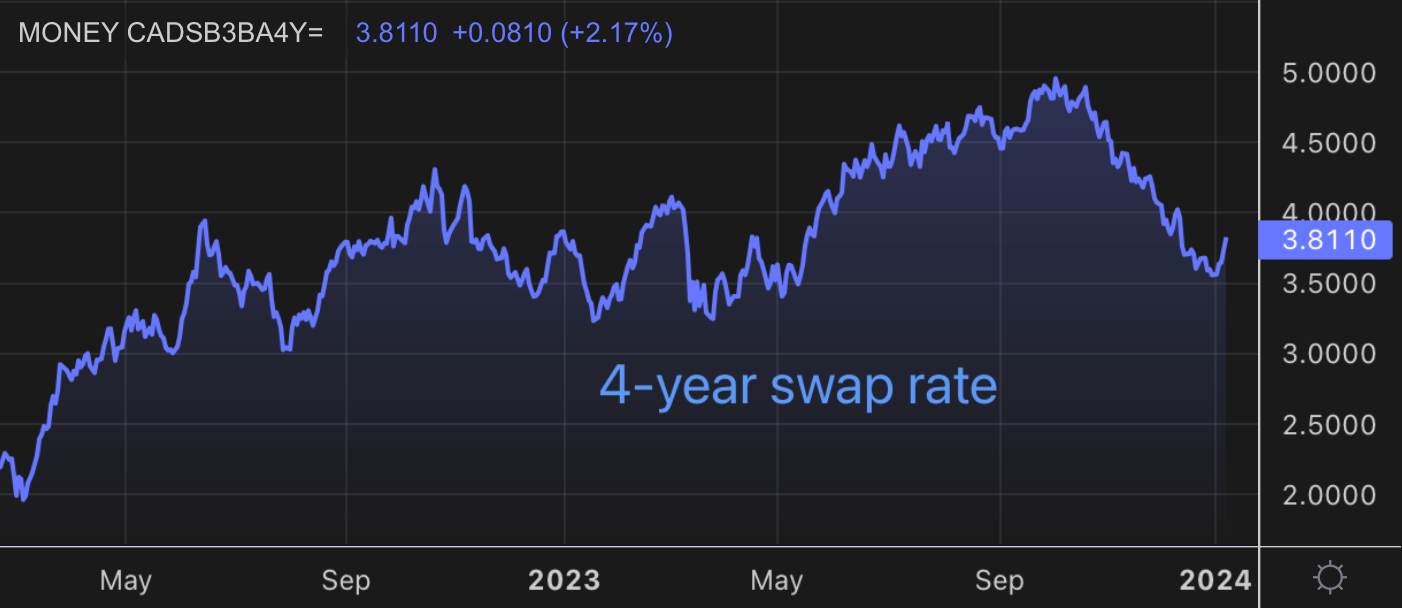
In the last three months of 2023, the 4-year swap rate—a leading indicator of fixed mortgage pricing—plunged 125 bps. The descent trimmed down fixed rates by about 60 bps.

Source: Refinitiv Eikon

For the average Joe/Josephine getting a new $300,000 mortgage, that means a cool $8,700 that they don't have to fork over in interest over the next five years. It's like finding a forgotten tax refund in your junk drawer.

Now, a 125 bps drop is no small decline, but it's a somewhat typical move when the market thinks rates have peaked. In the short term, however, some say the drop in yields was excessive, and maybe we all overdid it with the confetti and rate cut talk.

Or did we?

You don't have access to this post on MortgageLogic.news at the moment, but if you upgrade your account you'll be able to see the whole thing, as well as all the other posts in the archive! Subscribing only takes a few seconds and will give you immediate access.

This post is for MLN Pro subscribers only

Subscribe now
Back to top
You've successfully subscribed to MortgageLogic.news
Great! Next, complete checkout for full access to MortgageLogic.news
Welcome back! You've successfully signed in.
Unable to sign you in. Please try again.
Success! Your account is fully activated, you now have access to all content.
Error! Stripe checkout failed.
Success! Your billing info is updated.
Error! Billing info update failed.