
latest

News-Stream

For a minority of mortgage shoppers, the price of leverage is going up. Canada's banking watchdog, OSFI, has confirmed to MLN that it will enforce a new restriction on mortgage borrowing. "The LTI measure we are implementing is a portfolio test that is designed to prevent the

BREAKING: OSFI to Implement a Loan-to-Income (LTI) Limit

For a minority of mortgage shoppers, the price of leverage is going up.

Canada's banking watchdog, OSFI, has confirmed to MLN that it will enforce a new restriction on mortgage borrowing.

"The LTI measure we are implementing is a portfolio test that is designed to prevent the buildup of highly leveraged loans during low interest rate periods," an OSFI official told MLN today.

Unlike the #stress test#, which is a borrower-specific limit, "the Loan to Income (LTI) measure is a portfolio test," the regulator says. Hence, there's no rule that says an individual borrower can't have an LTI over 4.5x. It's the lender that will determine what LTI they'll allow, subject to all other underwriting guidelines.

"This measure means that institutions, in any quarter, can only have a certain percentage of their mortgages in excess of 4.5x LTI," OSFI says. Previously, OSFI contemplated a 25% allowance above that threshold, but now it will be case-by-case, depending on the lender.

The new limit "applies to the institution’s portfolio of underwritten mortgages that originate that quarter and needs to be managed by the institution."

For borrowers, here's what this means in practical terms.

You don't have access to this post on MortgageLogic.news at the moment, but if you upgrade your account you'll be able to see the whole thing, as well as all the other posts in the archive! Subscribing only takes a few seconds and will give you immediate access.

This post is for MLN Pro subscribers only

Subscribe now
Back to top

📰Also in this edition: • What the blockbuster immigration news means for real estate • Mortgage Bytes Well fancy this: a government watchdog is taking underdog borrowers under its wing. In a submission today to the Department of Finance, Canada's Competition Bureau (CB) defended unfairly treated mortgage switchers, saying it

Competition Bureau Pushes for Non-Stress Tested Uninsured Switches

📰
Also in this edition:
• What the blockbuster immigration news means for real estate
• Mortgage Bytes

Well fancy this: a government watchdog is taking underdog borrowers under its wing.

In a submission today to the Department of Finance, Canada's Competition Bureau (CB) defended unfairly treated mortgage switchers, saying it "urges policymakers to reconsider the application of the stress test at mortgage renewal for uninsured borrowers."

Doing so would "allow [borrowers] to switch lenders and benefit from competition," it explained.

What a concept. It kind of sounds like what the mortgage industry has been screaming from rooftops for 6+ years.

You don't have access to this post on MortgageLogic.news at the moment, but if you upgrade your account you'll be able to see the whole thing, as well as all the other posts in the archive! Subscribing only takes a few seconds and will give you immediate access.

This post is for MLN Pro subscribers only

Subscribe now
Back to top

The curtains just closed on the world's most important news conference for mortgage rates: the Fed rate announcement. If you want to know how it turned out, look no further than North America's 5-year yields. They're the financial market's real-time window into

Fed Signals 'Wait and See' in the Face of Inflation "Bumps"

The curtains just closed on the world's most important news conference for mortgage rates: the Fed rate announcement.

If you want to know how it turned out, look no further than North America's 5-year yields. They're the financial market's real-time window into the Fed's mind, and their verdict was a resounding shrug, with yields dipping a modest 5 bps on the day.

Coming into the meeting, rate sleuths sought clarity on the five policy mysteries below, and they largely got it.


#1 - Are three rate cuts still the expectation?

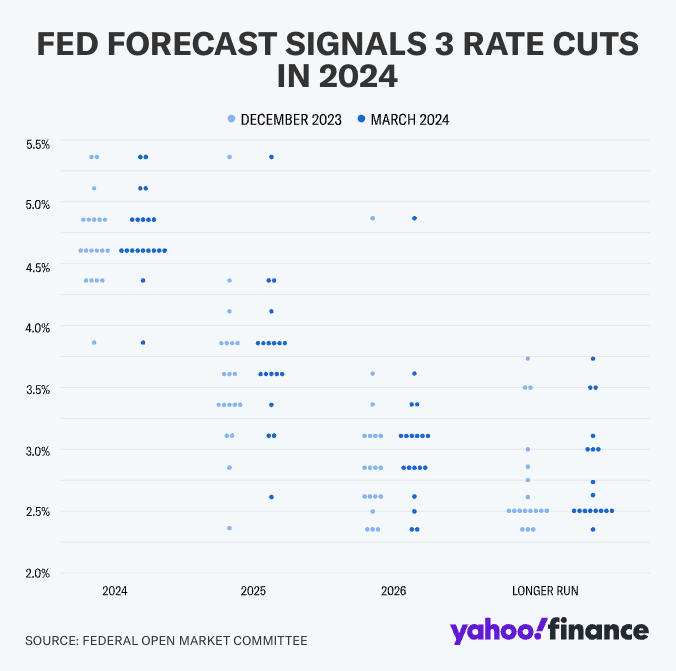
  • Answer: Yes. Monetary easing is likely “sometime this year,” Fed Chair Jerome Powell repeated. The Fed's fresh dot plot (projections) still show a hat trick of cuts before New Year's.
    ​​
Fed "Dot Plot" (Source: Yahoo Finance)

#2 - Is the Fed's #neutral rate# estimate now higher?

  • Answer: Yes. The long-term "dot" ascended from 2.5% to 2.6%, ending a 2.5% plateau that's lasted since mid-2019. In theory, this means mortgage rates may not fall as much as previously expected, but let's be real, 10 bps won't break the bank. Given the spending sprees on both sides of the border, consider borrowers fortunate if neutral rate increases stopped at a mere 10 bps.

#3 - How does the Fed view this year's firm inflation data?

  • Answer: Powell said higher-than-expected Jan./Feb. inflation hasn't changed the overall story of "bumpy" progress. "We were right to wait," he reflected, noting that he doesn't know if inflation's recent strength is "a bump in the road or something more." Either way, he's braced for a rocky path, and mortgagors should be too.

#4 - How worried is the Fed about growth, jobs, wages and financial conditions?

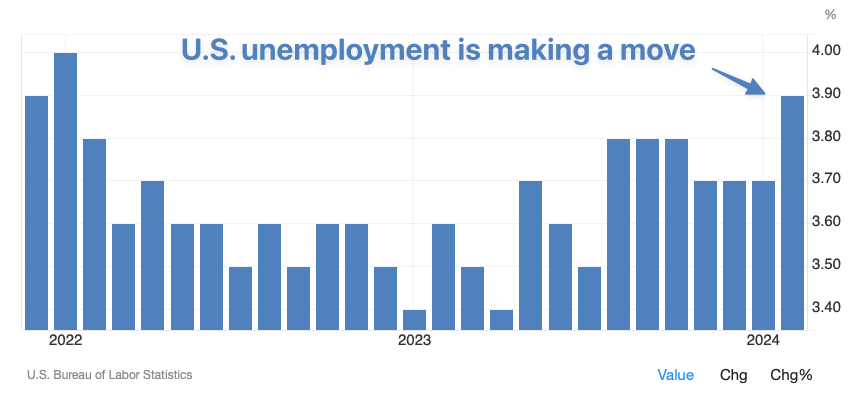
  • Answer: Powell was refreshingly straightforward on this. He said that solid growth, strong employment and easier financial conditions are not significant "problems" in and of themselves. In fact, the Fed raised its inflation and growth forecasts yet still expects inflation to trend towards 2%. Regarding hot wage growth, Powell said, "Our target is not wages, it’s inflation." He confirmed that significant weakening in the labour market could justify more accelerated rate cuts.
    ​​
Chart via Trading Economics

#5 - How long will meaningful rate cuts take

  • Answer: Absent a freak economic meltdown, the coming rate cut cycle could be a marathon instead of a sprint. FOMC members' crystal balls don't have core PCE inflation reaching the 2% target for almost two years. Mind you, the Fed will cut far ahead of that. Separately, Powell noted that #base effects# later this year may make it harder to make inflation progress. Seven of the next 12 months have tough comparables (i.e., monthly inflation of 0.2% or less). So, again, expect turbulence en route to 2%.
    ​​

Inflation data is king

Post-Fed meeting, markets took a collective exhale, confident that rate hikes remain off the menu despite a perky economy. Powell echoed that America's policy rate is still “likely at its peak,” and traders came out of the meeting still fully pricing in a rate cut by July.

The good news for Canadian mortgagors is that rate risk appears capped, especially given the Fed's willingness to tolerate more economic effervescence. Powell suggests it's probably just a waiting game at this point (someone queue the Jeopardy theme).

"Most importantly, we’re looking at incoming inflation data," Powell said. That makes next Friday's core PCE reveal a blockbuster we'll be popcorn-ready for.

Back to top

Amidst all the economic noise and reports we're bombarded with daily, inflation data reigns supreme. The monthly CPI report is the Bank of Canada's North Star, and yesterday, the cosmos smiled upon us with a twinkle that could signal lower rates. Canadian inflation limboed under expectations

Canada's Inflation Surprise: Potential Prelude to a Rate Cut Summer

Amidst all the economic noise and reports we're bombarded with daily, inflation data reigns supreme.

The monthly CPI report is the Bank of Canada's North Star, and yesterday, the cosmos smiled upon us with a twinkle that could signal lower rates.

​​Canadian inflation limboed under expectations for the second straight month, setting the stage for what could be a rate cut premiere this summer.

You don't have access to this post on MortgageLogic.news at the moment, but if you upgrade your account you'll be able to see the whole thing, as well as all the other posts in the archive! Subscribing only takes a few seconds and will give you immediate access.

This post is for MLN Pro subscribers only

Subscribe now
Back to top

Deciphering Forward Markets for Interest Rate Insights

You don't have access to this post on MortgageLogic.news at the moment, but if you upgrade your account you'll be able to see the whole thing, as well as all the other posts in the archive! Subscribing only takes a few seconds and will give you immediate access.

This post is for MLN Pro subscribers only

Subscribe now
Back to top

Forward rates are popular reference points that reflect the "smart money's" expectations for future interest rates. Who is the smart money? Think big institutional investors with deep pockets. For decades, investors have used forward rates to predict future rates. Despite the market's flaws, few

Deciphering Forward Markets for Interest Rate Insights

Forward rates are popular reference points that reflect the "smart money's" expectations for future interest rates.

Who is the smart money? Think big institutional investors with deep pockets.

For decades, investors have used forward rates to predict future rates. Despite the market's flaws, few rate prediction sources are more objective and credible. At a minimum, it beats your uncle's gut feeling at Easter dinner.

💡
MLN embeds forward rate assumptions in its Amortization Simulator.

Forward rates are also helpful when running borrowing cost scenarios and assessing potential mortgage affordability challenges.

But forward rates are often misunderstood. If you want a better feel for how markets anticipate rate direction changes, watch this fascinating video. It's based on American futures, but the principle also holds for Canadian rates.

You don't have access to this post on MortgageLogic.news at the moment, but if you upgrade your account you'll be able to see the whole thing, as well as all the other posts in the archive! Subscribing only takes a few seconds and will give you immediate access.

This post is for MLN Pro subscribers only

Subscribe now
Back to top

When times are tough, more people do stupid things. One thing some do is intentionally misrepresent themselves on mortgage applications to get approved. This kind of fact-fudging surged almost 10% y/y in Q4 2023, Equifax reported this month.

Loan Liars: Equifax Spots Alarming Trend

When times are tough, more people do stupid things.

One thing some do is intentionally misrepresent themselves on mortgage applications to get approved.

This kind of fact-fudging surged almost 10% y/y in Q4 2023, Equifax reported this month.

You don't have access to this post on MortgageLogic.news at the moment, but if you upgrade your account you'll be able to see the whole thing, as well as all the other posts in the archive! Subscribing only takes a few seconds and will give you immediate access.

This post is for MLN Pro subscribers only

Subscribe now
Back to top

"The Fed pivot in December has triggered an easing in financial conditions which can no longer be ignored," says private equity giant Apollo Global Management. As a result, the firm sees no Fed rate cuts this year. It's a minority view, but Apollo's not

Can Real Estate Appreciate With 5% Mortgage Rates?

"The Fed pivot in December has triggered an easing in financial conditions which can no longer be ignored," says private equity giant Apollo Global Management. As a result, the firm sees no Fed rate cuts this year.

It's a minority view, but Apollo's not alone. More contrarians have come out of the woodwork, maintaining that rates are renormalizing around today's higher levels. They're flagging everything from fiscal over-stimulation, housing strength, surging population (in Canada, not so much in the U.S.), rate insensitivity in the U.S. (due to 30-year mortgages), sticky inflation expectations, wage pressures, trade frictions, and onshoring—all of which are conspiring to slow disinflation.

The OIS and forward markets—which analysts turn to for rate predictions—are scratching their heads at this unprecedented combination of inflationary forces. There's a nagging concern that markets are not recognizing the inflation beast in the lineup.

If the consensus turns out to be wrong about monetary easing in 2024, it could rewrite the future for people's net worth. Rates are a crucial lever for home values, and home ownership is people's primary method of building wealth.

One can't help but ponder: if 5% mortgage rates theoretically became the new normal, could home prices keep reaching for the stars?

You don't have access to this post on MortgageLogic.news at the moment, but if you upgrade your account you'll be able to see the whole thing, as well as all the other posts in the archive! Subscribing only takes a few seconds and will give you immediate access.

This post is for MLN Pro subscribers only

Subscribe now
Back to top
You've successfully subscribed to MortgageLogic.news
Great! Next, complete checkout for full access to MortgageLogic.news
Welcome back! You've successfully signed in.
Unable to sign you in. Please try again.
Success! Your account is fully activated, you now have access to all content.
Error! Stripe checkout failed.
Success! Your billing info is updated.
Error! Billing info update failed.